Direct Targeted Methylation Sequencing (GDNA)

Native Methylation Meets Targeted Precision

Wasatch BioLabs’ Direct Targeted Methylation Sequencing (dTMS) is a scalable, cost-effective platform for targeted long-read sequencing and methylation analysis, designed for applications where whole-genome context is unnecessary or cost-prohibitive.Wasatch BioLabs' Direct Targeted Methylation Sequencing (dTMS) provides a scalable, cost-effective solution for region-specific analysis, ideal for applications where whole-genome sequencing is inefficient or expensive. Combining hybridization-based enrichment with nanopore sequencing, dTMS overcomes the limitations of traditional methods, including short-reads and synthetic DNA that erase native modifications.

By combining proprietary library prep protcols, modified Agilent SureSelect hybridization-based enrichment, and native, long-read Oxford Nanopore sequencing, dTMS overcomes the limitations of short-read and PCR-based approaches that can obscure structural variation and eliminate native epigenetic modifications. The result is high-depth, multiplexed interrogation of defined genomic regions while preserving methylation and long-range haplotypic context.

Download Whitepaper

Advantages

dTMS enables direct, native detection of sequence and methylation without bisulfite conversion or PCR amplification, reducing bias and preserving biological signal integrity.

Wtihin a single long-read workflow, the platform supports integrated detection of:

  • Small Variants (SNVs)
  • Short Tandem Repeat Expansions (STRs)
  • Phasing Haplotypes
  • Regional Methylation Patterns

Traditional TBS

Wasatch BioLabs dTMS

Long Reads

Single Molecule Resolution

Real-Time Analysis

PCR Bias-Free

Bisulfite Conversion DNA Damage-Free

DNA Sequence

Methylation

Hydroxymethylation

Potential For Additional
Base Modifications

*

Comparison of Targeted Methylation Approaches. Compared to traditional targeted bisulfite sequencing (TBS), Wasatch BioLabs’ Direct Targeted Methylation Sequencing (dTMS) uses native long-read nanopore sequencing to enable PCR- and bisulfite-free analysis of targeted regions. Filled indicators denote capabilities supported by each method.

Traditional TBS   Vs   WBL dTMS

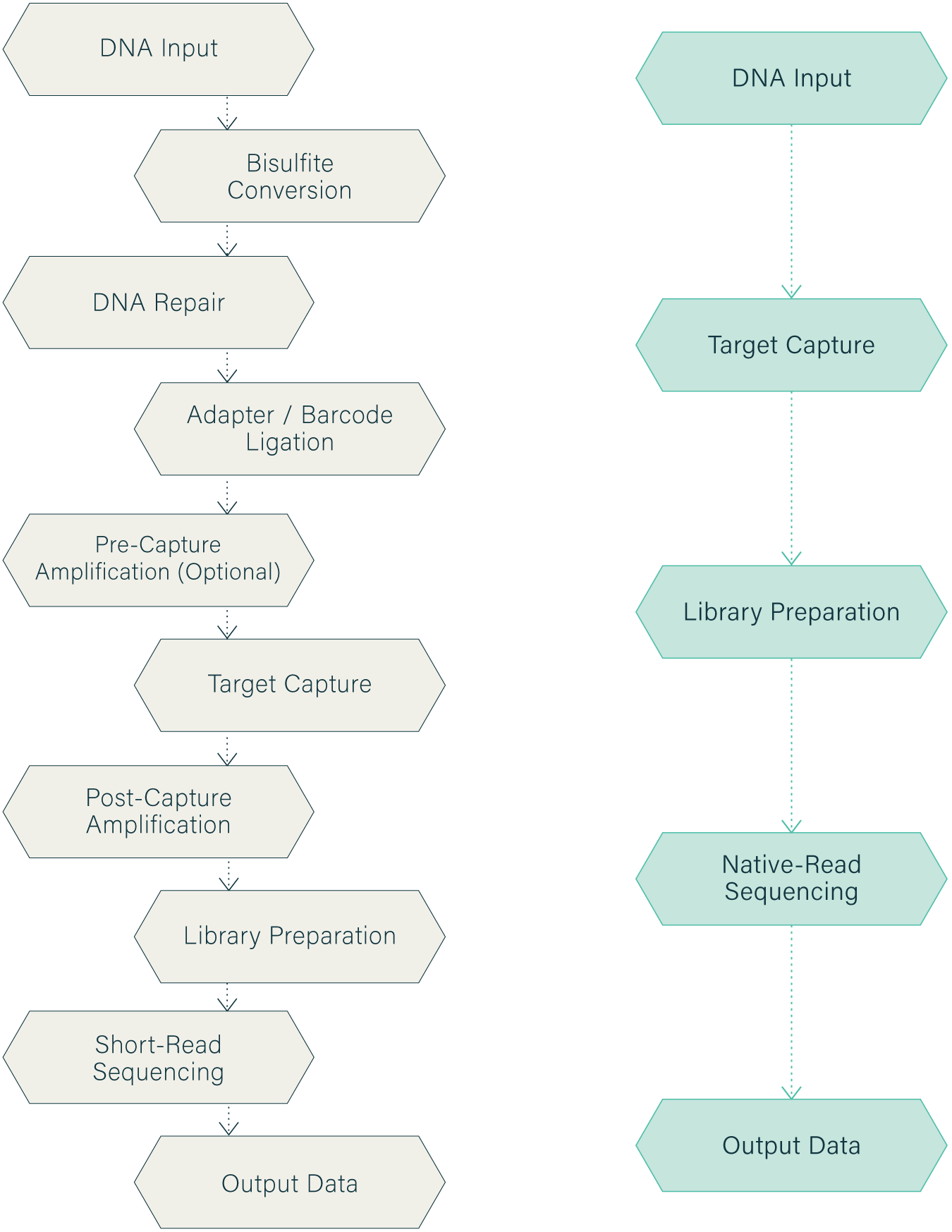
Workflow Comparison of Targeted Methylation Methods. Compared to traditional targeted bisulfite sequencing (TBS), Wasatch BioLabs’ Direct Targeted Methylation Sequencing (dTMS) uses hybridization-based capture and native long-read nanopore sequencing to preserve native epigenetic modifications and long-read context, bypassing biases introduced by bisulfite conversion and PCR amplification.

A Technical Comparison

Conventional hybrid capture methods are optimized for short-read sequencing and rely on amplification steps that fragment DNA and erase native epigenetic information.

dTMS extends hybridization-based enrichment into the long-read domain through proprietary library preparation protocols that preserve native molecules. This approach enables:

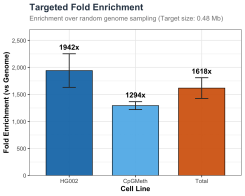
  • 1,200x target enrichment in characterized panels
  • High-confidence SNV detection (F1 >99% with adequate coverage)
  • Reliable STR sizing (>20 spanning reads improves accuracy to ~89%)
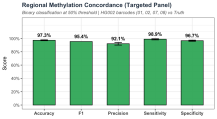
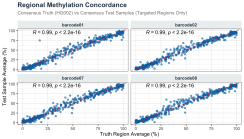
  • Regional methylation accuracy ~97% with strong concordance (R² ≥ 0.99)

dTMS Characterization

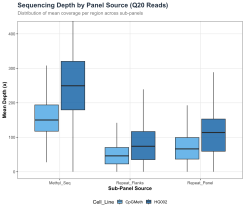
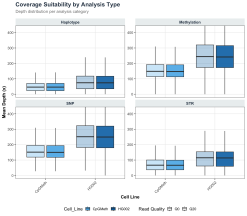
Targeted Performance Overview. dTMS achieved 1,200–1,900x enrichment across targeted regions (A), supporting high-depth sequencing without whole-genome coverage. In benchmark comparisons using the ONT HG002 reference dataset, SNV detection exceeded 98% accuracy after depth and quality filtering (B). STR sizing accuracy surpassed 89% when ≥20 repeat-spanning reads were obtained, demonstrating reliable repeat inference at sufficient coverage (C).

Regional Methylation Performance. Regional CpG methylation profiling demonstrated ~97% overall accuracy compared to whole-genome nanopore reference data (A), with strong precision at the regional level. Concordance of regional methylation values was high (R² ≥ 0.99), confirming reproducible detection of broader epigenetic patterns across targeted loci (B).

dTMS Characterization

Targeted Performance Overview. dTMS achieved 1,200–1,900x enrichment across targeted regions (A), supporting high-depth sequencing without whole-genome coverage. In benchmark comparisons using the ONT HG002 reference dataset, SNV detection exceeded 98% accuracy after depth and quality filtering (B). STR sizing accuracy surpassed 89% when ≥20 repeat-spanning reads were obtained, demonstrating reliable repeat inference at sufficient coverage (C).

Targeted Performance Overview. dTMS achieved 1,200–1,900x enrichment across targeted regions (A), supporting high-depth sequencing without whole-genome coverage. In benchmark comparisons using the ONT HG002 reference dataset, SNV detection exceeded 98% accuracy after depth and quality filtering (B). STR sizing accuracy surpassed 89% when ≥20 repeat-spanning reads were obtained, demonstrating reliable repeat inference at sufficient coverage (C).

Targeted Performance Overview. dTMS achieved 1,200–1,900x enrichment across targeted regions (A), supporting high-depth sequencing without whole-genome coverage. In benchmark comparisons using the ONT HG002 reference dataset, SNV detection exceeded 98% accuracy after depth and quality filtering (B). STR sizing accuracy surpassed 89% when ≥20 repeat-spanning reads were obtained, demonstrating reliable repeat inference at sufficient coverage (C).

Regional Methylation Performance. Regional CpG methylation profiling demonstrated ~97% overall accuracy compared to whole-genome nanopore reference data (A), with strong precision at the regional level. Concordance of regional methylation values was high (R² ≥ 0.99), confirming reproducible detection of broader epigenetic patterns across targeted loci (B).

Regional Methylation Performance. Regional CpG methylation profiling demonstrated ~97% overall accuracy compared to whole-genome nanopore reference data (A), with strong precision at the regional level. Concordance of regional methylation values was high (R² ≥ 0.99), confirming reproducible detection of broader epigenetic patterns across targeted loci (B).

The Setup Process

More Than a Service Provider —Your Trusted Partner

From exploratory profiling to targeted panel development, Wasatch BioLabs delivers high-confidence sequencing grounded in validation, reproducibility, and operational rigor.

We combine proprietary enrichment technologies, scalable workflows, and expert bioinformatics to generate actionable multi-omic data suitable for research and translational applications.

Proprietary, Flexible Solutions

[Service]

Workflows scale from early discovery studies to translational panel development, with optimization ongoing to expand fragment length and structural variant resolution.

Bioinformatic Expertise

[Service]

Sequencing performance depends on downstream analysis. Our bioinformatics team deploys custom pipelines to generate impactful, publication-ready insights.

One-On-One Collaboration

[Service]

Each project is supported by sequencing scientists and bioinformatics experts who guide study design, panel optimization, and data interpretation.

Our goal is not only data generation, but disciplined execution, ensuring biological signal integrity from sample to insight.

Specialized offerings in our next-generation Biolab

Explore our other Services

FAQ

How does Wasatch BioLabs’ dTMS detect specific methylation sites?

dTMS combines hybridization-based target enrichment with native Oxford Nanopore sequencing to precisely focus on genomic regions of interest. Using Agilent’s SureSelect (for gDNA) or Avida (for cfDNA) chemistries, dTMS enriches selected loci while preserving native DNA.

How does Wasatch BioLabs ensure accuracy and specificity in targeted methylation sequencing?

dTMS combines hybridization-based target enrichment with native Oxford Nanopore sequencing to precisely focus on genomic regions of interest. Using Agilent’s SureSelect (for gDNA) or Avida (for cfDNA) chemistries, dTMS enriches selected loci while preserving native DNA.

How does Wasatch BioLabs ensure accuracy and specificity in targeted methylation sequencing?

Accuracy and specificity are achieved through optimized library preparation, hybrid capture enrichment, and native long-read Oxford Nanopore sequencing. By avoiding PCR amplification and chemical conversion, this approach minimizes bias and preserves native DNA context, enabling precise, reproducible, single-molecule methylation measurements at targeted loci.

How customizable are the targeted regions for methylation sequencing at Wasatch BioLabs?

Target regions are highly customizable. Researchers define their regions of interest, and Wasatch BioLabs designs a tailored probe set to match those targets. The dTMS workflow can be adapted to specific genes, regulatory elements, or CpG-rich regions, supporting both focused discovery and validation studies.

What sample types are compatible with targeted methylation sequencing?

Direct Targeted Methylation Sequencing (dTMS) is optimized for high-quality genomic DNA (gDNA). Intact DNA enables accurate, long-read analysis of both sequence and methylation while avoiding DNA damage associated with bisulfite-based methods.

What kind of data output and reporting does Wasatch BioLabs provide for targeted methylation sequencing?

Wasatch BioLabs provides analysis-ready sequencing and methylation data, including 5mC/5hmC levels, phasing, and variant calls within targeted regions, with bioinformatics support and reporting to support downstream analysis and interpretation.

What advantages does targeted DNA methylation sequencing offer for focused research or clinical studies?

Targeted native-read methylation sequencing provides a cost-efficient way to interrogate specific genes or regions of interest while preserving native DNA modifications. By avoiding PCR and chemical conversion, it delivers accurate, low-bias methylation data well suited for biomarker discovery, focused translational studies, and clinical assay development.

How does Wasatch BioLabs support clients in designing custom targeted methylation panels?

Wasatch BioLabs partners closely with clients to define regions of interest and design custom capture panels. We provide end-to-end support from study design and probe development to sequencing, analysis, and reporting to ensure each panel is tailored to your project.